

How to Set & Maintain Boundaries After Sexual Trauma
(At Any Stage of Healing)
By Melissa Huff, 2026 Clinical Intern
Boundaries can be difficult for anyone, but after experiencing sexual trauma, they can feel confusing and hard to establish. When your sense of safety or bodily autonomy has been violated, it can change how you understand your own limits and how you respond in the moment.
You might notice yourself second guessing what you’re comfortable with, freezing instead of speaking up, or putting other people’s needs ahead of your own just to feel safe.
For people who’ve experienced sexual trauma, boundaries aren’t just a general life skill, they become an important part of healing and reconnecting with yourself. In this guide, we’ll start by talking about what boundaries are, and then explore how trauma can impact them, along with ways to begin identifying, setting, and maintaining boundaries in a way that feels safe and supportive.
Before we begin: if you want a more guided way to reflect on your own experiences, you can download our Relationship & Sexual Boundaries Worksheet. You can use it alongside this guide or return to it whenever you need extra structure and support.
What Are Boundaries?
Boundaries are the limits we set to protect the most important parts of ourselves. They safeguard our bodies, ensuring that our physical space and well-being are respected. They also protect our emotions, allowing us to feel and express ourselves without being overwhelmed or manipulated by others. Healthy boundaries help us manage our time and energy so we’re not constantly overextended or drained. They support our sexual autonomy by affirming that we have the right to choose what we are and are not comfortable with. Ultimately, boundaries create a sense of safety, helping us maintain control over our lives and relationships while honoring our needs and values.
Boundaries are not walls.
They are not punishments.
They are not selfish.
Boundaries are acts of self-protection and self-respect.
It’s also important to understand the difference between boundaries and rules. Rules are often about controlling or directing someone else’s behavior, basically telling another person what they must or must not do. Boundaries, on the other hand, focus on self-respect and personal responsibility. Instead of trying to control others, boundaries communicate what we will do to take care of ourselves if a limit is crossed. In this way, boundaries are not about power over others; they are about honoring our needs and protecting our well-being
Self-respect is at the heart of healthy boundaries. When we respect ourselves, we recognize that our needs, feelings, and limits matter just as much as anyone else’s. Self-respect means giving ourselves permission to take up space, to say no when something doesn’t feel right, and to prioritize our well-being without guilt. It encourages us to listen to our inner voice and trust when something feels uncomfortable, unsafe, or draining.
Why Boundaries Can Feel Especially Hard After Sexual Trauma
If you’ve experienced sexual trauma, struggling with boundaries makes a lot of sense.
Boundaries are about safety, choice, and having control over your own body and experiences. When those things have been taken away or ignored in the past, it can make it harder to know what your limits are now or to feel confident expressing them.
One reason for this is how trauma impacts the nervous system. When something feels overwhelming or unsafe, your body may automatically move into a survival response, often called fight, flight, freeze, or fawn. These responses happen quickly and are not conscious choices. They are your body’s way of trying to protect you.
Here’s how these responses might show up:
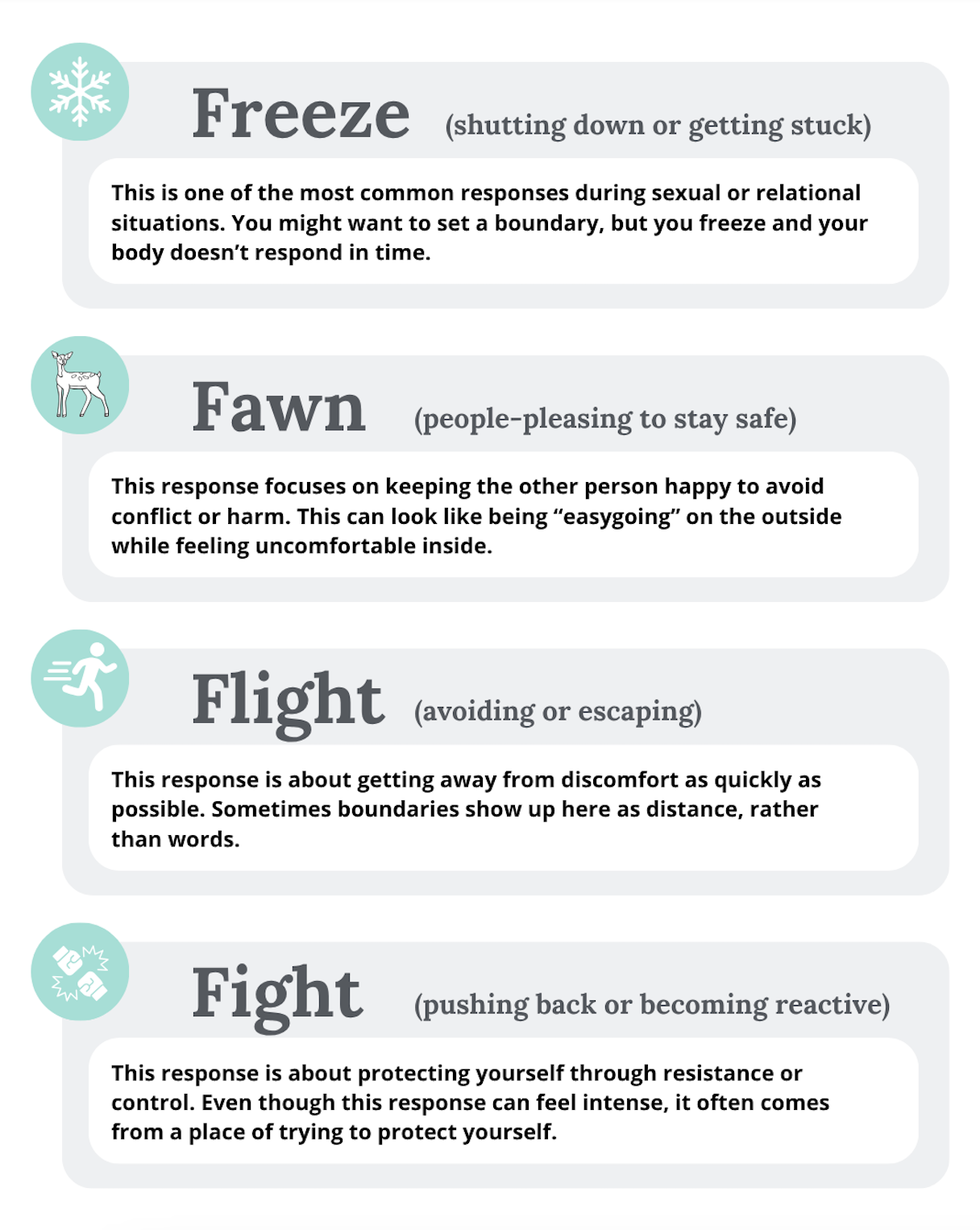
You might see yourself in one of these responses, or move between several depending on the situation. There’s no “right” way your body responds. These responses are not your fault; they are patterns your body learned to keep you safe.
The following guide will walk you through the steps of identifying, setting, and maintaining boundaries. As you begin practicing boundaries, understanding your default response can help you plan in ways that feel more supportive. For example, if you tend to freeze, you might practice more short scripts ahead of time. If you tend to fawn, you might focus more intentionally on noticing when you’re prioritizing someone else over yourself. If you tend to avoid, you might benefit from spending extra time on practicing small, low-risk moments of connection.
Step 1: Notice Your Body’s Signals
If you don’t know where to begin, begin here. Your body often knows before your mind does.
After experiencing trauma, your body may react quickly to situations that feel uncomfortable, overwhelming, or unsafe. These reactions can show up as the fight, flight, freeze, or fawn responses mentioned above, and each one has its own physical cues.
Learning to recognize these signals can help you pause, check in with yourself, and better understand when a boundary might be needed.
Here are some ways these responses might feel in your body:
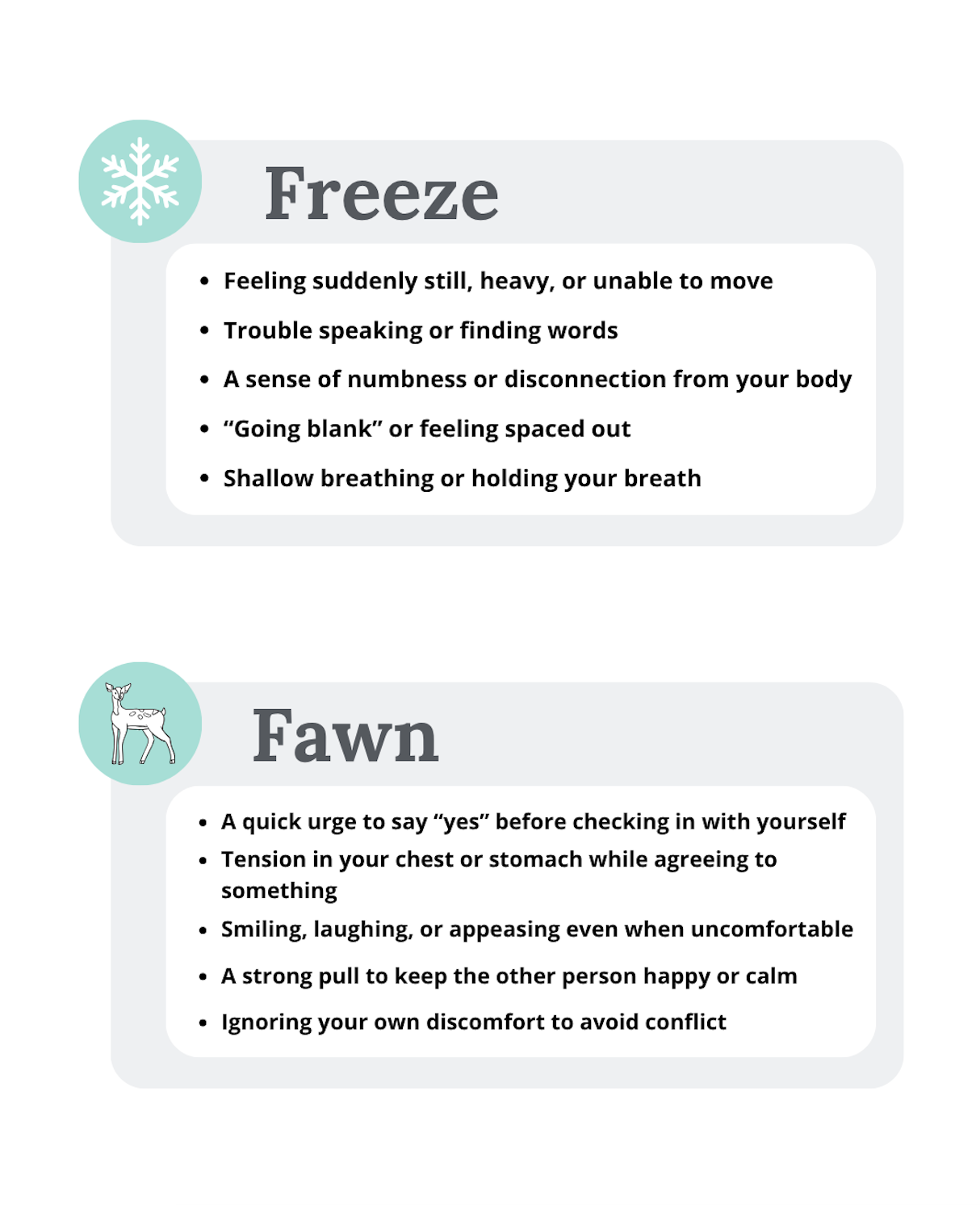
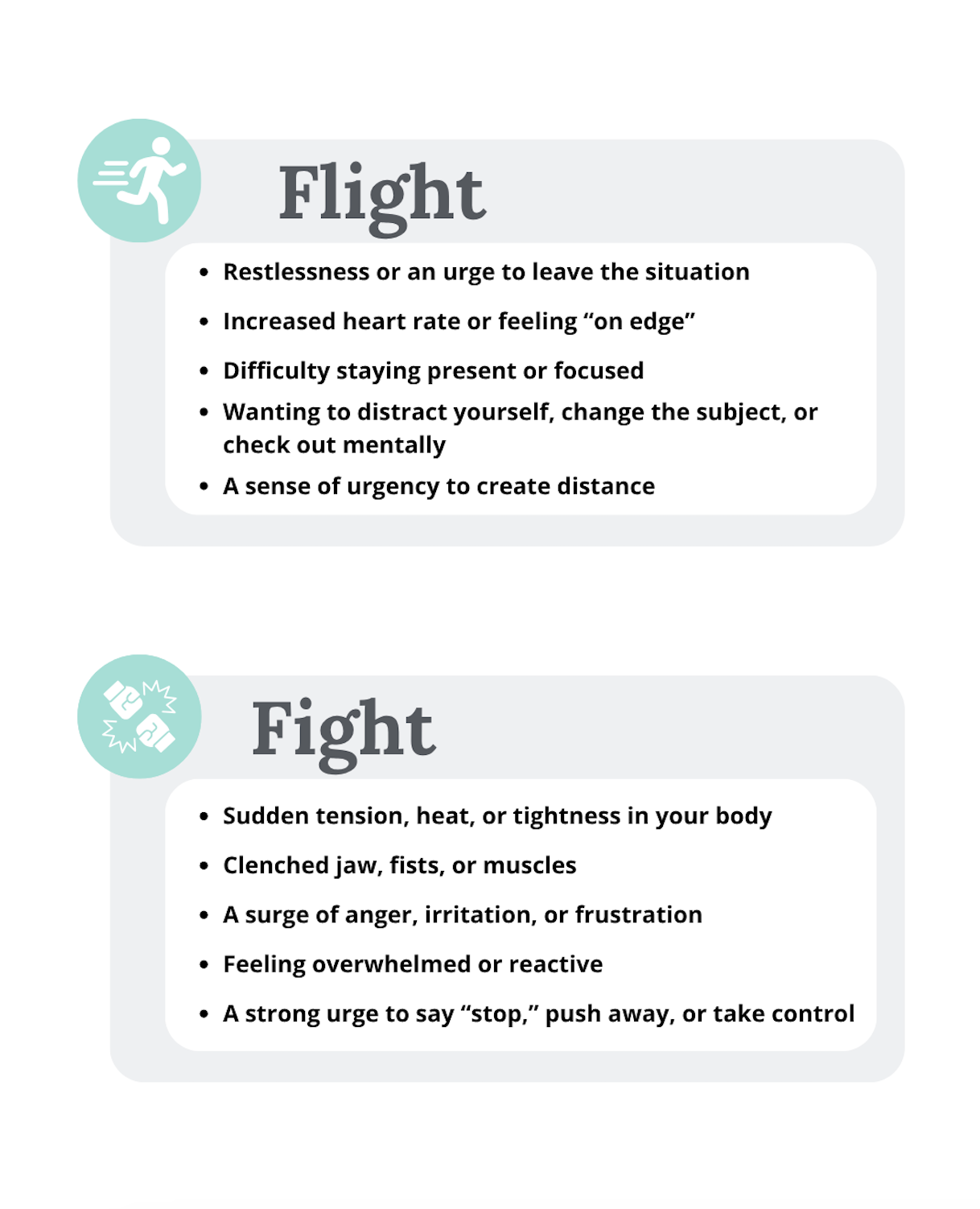
You may notice one of these responses more than others, or experience a mix depending on the situation. As you practice noticing them, you can start to pause and ask yourself:
- What am I feeling right now?
- What does my body need?
- Is there a boundary I want to set here?
You don’t have to respond perfectly in the moment. Even recognizing these signals after the fact is a powerful step toward rebuilding trust with your body and honoring your boundaries over time.
Step 2: Identify Common Boundary Struggles After Trauma
Think about times where you can look back and recognize your body’s signals and responses. Who was involved? What was the context? What did they do? How did you respond in the moment? How do you wish you would have responded instead?
If you see a pattern around one person, you might need to set boundaries with them specifically. If you see a pattern around sexual situations or types of communication, you may need to set a more general boundary for yourself.
Many survivors find that their relationship with boundaries and intimacy becomes complicated after experiencing harm. They may say yes when they truly mean no, or feel responsible for managing other people’s sexual feelings and expectations. In difficult moments, some people freeze instead of speaking up, while others cope by avoiding intimacy altogether. Survivors might also over accommodate others in an effort to feel safe, pushing aside their own comfort or desires.
It’s common to feel guilty for having needs or to struggle with not knowing what you actually want. These responses are not personal failures; they are often protective strategies the mind and body developed to survive. With time, support, and self-compassion, many people gradually relearn how to recognize their needs and express their boundaries in ways that feel safer and more empowering.
Step 3: Consider Types of Boundaries
Boundaries are not one-size-fits-all; they exist in many areas of our lives and help us communicate what makes us feel safe, respected, and comfortable. Learning the language of boundaries can take practice, especially for people who were never encouraged to express their needs. Simple, clear statements can help communicate limits without needing long explanations or justifications. Over time, practicing these kinds of statements can build confidence and make it easier to advocate for yourself in different situations.
Emotional Boundaries
Emotional boundaries help us protect our inner world and personal experiences.
- “I don’t want to talk about that.”
- “I need space before continuing this conversation.”
- “I’m not ready to share that part of my story.”
Physical Boundaries
Physical boundaries relate to our personal space and touch.
- “I’m not comfortable hugging.”
- “Please ask before touching me.”
- “I need more space.”
Digital Boundaries
Boundaries can also exist in our digital lives to help us feel safe and respected.
- “I don’t send explicit photos.”
- “Please don’t text me late at night.”
- “I’m not comfortable with sexual messages.”
Sexual Boundaries
Sexual boundaries communicate comfort and consent in intimate situations.
- “I’m not ready for that.”
- “I only feel safe with slow progression.”
- “Condoms are required.”
- “I don’t want sex tonight.”
If you’ve experienced sexual trauma, it’s likely that physical and sexual boundaries may feel especially complicated. Because past experiences may have involved pressure, coercion, or having your consent ignored, it can be harder to recognize what you truly want, trust your instincts, or feel confident expressing limits in the moment. You might notice a tendency to go along with things, feel unsure where your comfort level is, or struggle to slow things down once intimacy has started. Setting boundaries in these areas may take more time and patience, as you gain confidence in advocating for yourself. And that’s okay.
Step 4: Practice Low-Risk Boundary Building
Building boundary skills doesn’t have to start in high-pressure or deeply personal situations. In fact, it can be helpful to begin with small, low-risk moments in everyday life. This might look like:
- Sending food back at a restaurant when something isn’t right
- Saying “I can’t make it” to a plan that doesn’t work for you
- Letting a phone call go to voicemail when you need quiet time
- Taking longer to respond to texts instead of feeling pressured to reply immediately
- Choosing what movie you want to watch instead of automatically deferring to others
These small moments give you the chance to practice listening to your needs and expressing them. Boundaries are like a muscle: the more you practice in low-stakes situations, the stronger and more natural they become over time.
Step 5: Scripts You Can Borrow
Finding the right words to express a boundary can feel difficult, especially in moments when emotions are high or your body goes into a freeze response. Having simple phrases prepared ahead of time can make it easier to speak up when you need to. These short scripts can act as tools you can borrow until the language begins to feel more natural.
If words freeze in your throat, try these:
- “I’m not comfortable with that.”
- “I need to slow down.”
- “Can we pause?”
- “I’m not sure how I feel yet.”
- “That doesn’t work for me.”
- “I need time to think.”
And sometimes, the clearest boundary is simply saying “No.” Practicing these phrases can help build confidence and remind you that you’re allowed to protect your comfort and pace.
Step 6: Maintain Those Boundaries
Setting a boundary is an important step, but maintaining it is where many people struggle, especially after trauma. If your boundaries were ignored or violated in the past, it can feel especially hard to trust that they will be respected now.
If you clearly communicate a boundary and someone crosses it, you might feel frustrated, confused, or even triggered. When this happens, pause, remind yourself that you’re allowed to have limits, and restate the boundary clearly.
For example:
- “I said I’m not comfortable with that.”
- “I need you to stop.”
- “I’m not available for this conversation right now.”
Sometimes, especially in the moment, your body may freeze or you may not respond right away. That’s okay. You are still allowed to reinforce your boundary later.
As you continue practicing this, you may begin to notice that simply stating a boundary is not always enough to have it respected. This is where consequences come in. A consequence is not about punishing the other person: it’s about what you will do to protect yourself if your boundary is not honored. In this way, consequences bring your boundary into action.
For example, you might say, “If you keep making those comments, I’m going to leave the conversation,” or “If you don’t ask before touching me, I’m going to step away.”
Following through can feel uncomfortable, especially if you’re used to prioritizing others, but it is a key part of building self-trust. Each time you honor your boundary, you reinforce the message that your needs matter.
Over time, patterns may become clearer. If someone occasionally makes a mistake and is willing to repair and respect your boundary moving forward, that can be part of a healthy dynamic. However, if someone repeatedly ignores, dismisses, or pushes against your boundaries, it’s important to take that seriously. Ask yourself these questions:
- Do you feel safe expressing your needs?
- Does this person show a willingness to respect your limits?
- How do you feel after interacting with them?
If those patterns continue, maintaining your boundary may require creating more distance. This could look like limiting contact, changing the nature of the relationship, or ending the relationship altogether. Choosing to step away can be incredibly difficult, especially if you’ve learned to minimize your needs or prioritize connection at all costs. But if someone consistently violates your boundaries or makes you feel unsafe, the relationship may not be able to support your healing. In those moments, distance is not a failure; it is an act of self-protection and self-respect.
As you move through this process, it’s important to remember that boundaries are not fixed rules you have to get “perfect.” They are a practice. You are allowed to change them over time, reinforce them more than once, take space when you need it, and prioritize your safety and well-being. Maintaining boundaries can feel uncomfortable at first, but with time, it can help you rebuild trust with yourself and create relationships that feel safer, more respectful, and more aligned with your needs.
If You Feel Unsafe
If setting or maintaining boundaries because of abuse, manipulation, threats, financial dependence, or a power imbalance, your safety comes first.
If you are in the U.S., you can contact:
- RAINN (800-656-HOPE)
- National Domestic Violence Hotline (800-799-SAFE)
If outside the U.S., consider contacting local sexual assault or domestic violence support services in your country.
Words Of Encouragement (In Case Nobody Has Told You)
You are allowed to have limits.
You are allowed to take up space.
You are allowed to feel safe in your own body.
You are not “too sensitive.”
You are not “leading someone on.”
You are not responsible for someone else’s arousal.
You can revoke consent at any time.
Healing is not linear.
Additional Support
As you move through this process, it can be helpful to have something concrete to return to.
Our Sexual & Relationship Boundaries Worksheet is designed to guide you through the same steps outlined in this article: helping you identify patterns, clarify your needs, practice boundary language, and plan how to follow through. You can use it at your own pace, revisit it over time, or bring it into therapy as a starting point for deeper conversations.
Working with a therapist can help you explore your needs, build confidence in your boundaries, and move at a pace that feels right for you. If you’re ready for that support, we’re here to help.
Click the button below to get connected with a sex therapist for in-person or virtual therapy.
Recent Comments