

How many times do you pass a mirror each day?
One day, I stopped and realized just how often I come face to face with my own reflection. Mirrors are everywhere. While brushing my teeth, getting dressed, passing a store window, or checking myself before walking out the door. And yet, I realized how rarely I actually observed what I saw. More often, I was either avoiding my reflection altogether or hyperfocused on the things I did not like, the blemishes, the imperfections, the parts of my body I had learned to critique. And the more I thought about it, the more I realized this probably is not unique to me. So many of us have learned to look at our bodies without really seeing them.
What would happen if we intentionally slowed down and looked? Not to critique, evaluate, or search for flaws. Just to observe.
For many of us, looking at our bodies, whether alone, getting dressed, or in an intimate moment with a partner, can feel vulnerable or uncomfortable. We live in a culture that constantly tells us what our bodies are supposed to look like, how they are supposed to change, and what we should be doing to make them “better.” Take social media for example: diet culture content, constant comparison, critical comment sections, and editing apps that promote unrealistic beauty standards. It is easy to internalize those body-image messages without even realizing it. Before long, looking at ourselves can become less about noticing and more about judging, comparing our bodies to someone else’s, picking apart what we wish were different, or avoiding our reflection altogether. Somewhere along the way, we can lose the ability to simply be present with the body we actually have.
Intentional mirror work gently interrupts this pattern. The goal is not to love every part of your body, but to become more familiar with it through curiosity rather than criticism. With practice, this can support greater body awareness, less shame, and more ease in your own skin, including in the moments you feel most exposed with a partner.
Common Myths About Body Acceptance
Myth #1: Body acceptance means loving everything you see
Body acceptance does not require constant positivity. It is normal for your relationship with your body to shift from day to day. The goal is not to love every single part of your body, but to be able to exist in your body without constantly feeling the need to judge or change it.
Myth #2: Looking at your body will make you more critical
At first, you may find yourself being more critical. However, when you are used to avoidance or harsh judgment, neutrality can feel unfamiliar. Over time and with practice, you may find that it becomes easier to notice your body without immediately searching for something to criticize.
Myth #3: Body positivity is the only goal
Body positivity can be helpful, but feeling positively about your body all the time can feel unrealistic. Instead, a goal could be to just feel more neutral about your body.
Body Positivity vs. Body Neutrality
Body positivity emphasizes appreciation and celebration of the body. Body neutrality emphasizes that your worth is not determined by your appearance. Instead of “I love my stomach,” body neutrality might sound like “This is my stomach” or “My stomach supports my body and helps it function.” Rather than asking you to feel positively about your body at all times, neutrality invites simple acknowledgment without constant judgment.
Using The Mirror As a Mindfulness Practice
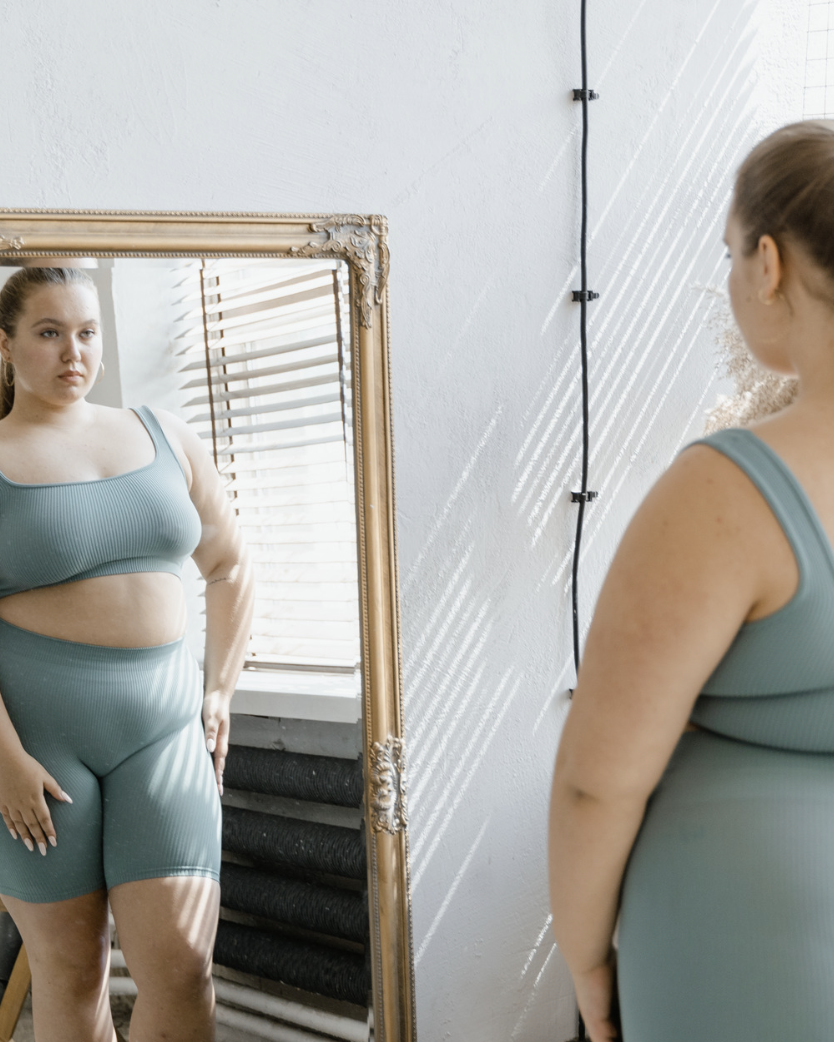
Rather than avoiding the mirror, I have come to learn that the mirror can actually be a useful tool to practice mindfulness and to notice my body without immediately judging it. Instead of looking for flaws or deciding what needs to change, I like to slow down and pay attention to what I actually see. Below are a few simple ways to practice being more mindful the next time you look in the mirror.
1. Try a Neutral Body Scan
Stand in front of a mirror, wearing minimal clothing if comfortable. Take a few slow breaths and gradually move your attention from head to toe, noticing each area without judgment.
As you look, try describing your body the way you might describe a landscape. For example, instead of “My thighs are too big,” try “My thighs take up space and support movement.” Instead of “I hate my stomach,” try “My stomach has a natural shape.” The focus is not positivity, but neutrality.
2. Practice Gratitude for Function
Shift attention toward what your body allows you to do. Your legs carry you through the world. Your arms let you hug the people you love, reach for what you need, and get things done. Your stomach processes food which gives you the energy you need to keep going. Your body has supported you through every stage of life and also allows you to feel pleasure and connect intimately with others. Sometimes it feels good to remember that your body is more than what you can see in the mirror.
3. Notice Emotional Reactions
Different emotions may arise, including discomfort, sadness, curiosity, or neutrality. All responses are valid. You do not have to fix or change the feeling. Just give yourself a moment to notice it.
Afterward, take a few moments to reflect. Ask yourself:
- What thoughts come up when I see my body?
- Where did I learn these beliefs?
- Would I speak to someone I care about this way?
- What areas do I judge most often?
- What changes when I approach my body with curiosity?
- How does my relationship with my body affect how comfortable I feel with intimacy?
- How tied is my worth to my appearance?
- What shifts if my worth is not based on how I look?
These questions can help surface patterns that often operate automatically.
Practical Ways to Build Body Neutrality
If body positivity feels out of reach, body neutrality can be a more realistic goal instead. This might look like spending a few moments looking at yourself without immediately picking yourself apart, wearing clothing that fits comfortably, or noticing comparison when it arises. It can also mean becoming more intentional about what you see online. On social media, it can be helpful to follow people who have bodies that look like yours, especially people that make you feel less alone in your body. This can help with challenging the idea that there is only one way a body is supposed to look.
The focus is not on changing your body, but on changing your relationship with how you see it.
In Conclusion…
Your relationship with your body is a relationship, and like any relationship, it develops through attention, curiosity, and care. You do not need to force confidence or love every part of yourself. Acceptance does not require you to change your body first. Sometimes it begins with something simple: standing in front of a mirror, taking a breath, and allowing yourself to be seen.
You only get one body, and you are not alone in learning how to live in it. So the next time you pass a mirror, I hope you are able to take a moment to pause. And if you are someone who has learned to avoid mirrors altogether, maybe this is an invitation to join me in slowly learning to stop looking away.
If body image has ever gotten in the way of feeling present or confident during intimate moments, a sex therapist may be a helpful source of support. Click the button below to reach out and get connected with a member of our team today.
Recent Comments