

Imagine things are heating up with your partner and all signs are pointing to really hot sex. The clothes are coming off, the toys are coming out, and the consent is ~enthusiastic~. But suddenly, you notice your attention shift from the spicy interaction to the thought of “what if I can’t stay hard?” Now you notice your erection isn’t as firm. You can feel the anxiety creeping in and then you lose the erection completely.
Sound familiar? Difficulty getting or maintaining an erection occasionally is a very common experience and doesn’t necessarily mean that you have erectile dysfunction. However, if this happens regularly and it is causing stress or interfering with your sex life, it may be worth talking with a sex therapist.
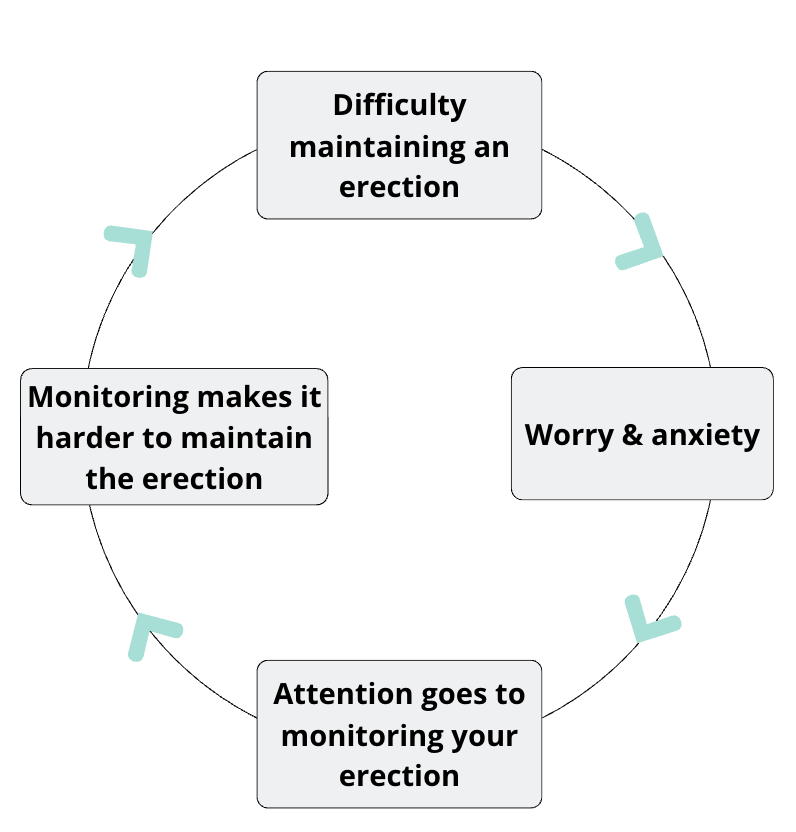
Erectile dysfunction is difficulty obtaining or maintaining an erection, or having erections that are less firm, during at least 75% of sexual encounters for a minimum of six months. While there may or may not be an underlying medical cause of ED, there are usually psychological and emotional components that exacerbate the problem. ED often brings up strong thoughts and feelings, such as embarrassment, anxiety, shame, insecurity, and fear about what it means for your relationship. These thoughts and feelings are not only caused by erectile dysfunction, but they actually make it more likely that ED is going to happen again in future sexual encounters, which is how the whole thing can turn into a loop.
The Frustrating Loop of Anxiety
One of the toughest parts of ED can be the anxiety that builds up around it. Say you lose your erection once during sex. The next time you’re intimate with your partner, a little voice starts up with, “is this going to happen again?” You start checking in on yourself, noticing any slight change, and immediately spiral into “oh no, here we go.” Your attention drifts away from what’s actually happening and locks onto monitoring your erection instead. At that point, you’re not really having sex anymore, you’re evaluating yourself and your performance.
That’s how the cycle gets going. It might start from any point: worry, monitoring, or physical changes. But eventually it follows the same vicious cycle.
The bottom line is that the more pressure you put on yourself to perform, the harder it becomes to actually relax into the moment and feel any pleasure at all.
What Might Be Contributing?
Now you might be thinking: Okay, yeah… That loop is very relatable but what’s causing it in the first place?!
Honestly, almost anything can throw off how your body responds sexually: stress, exhaustion, a few too many drinks, medications, tension with your partner, or just having an “off” day. Basically, don’t assume it’s all in your head, but don’t assume it’s purely physical either.
When we’re helping someone work through a concern like this, sex therapists like to zoom out and look at the whole picture instead of hunting for one single cause. Sometimes there’s one obvious culprit. Other times there are several things layered on top of each other. A few questions we might ask:
- Physically: Are medications, health conditions, hormonal shifts, sleep, alcohol, or substance use playing a role?
- Emotionally: Is anxiety, depression, chronic stress, shame, body image, or self-esteem part of the picture?
- Relationally: Is there conflict, tension, mistrust, or a sense of disconnection between you and your partner?
- Situationally: Are you rushed, in an unfamiliar space, worried about being interrupted, or feeling pressure due to time constraints?
Most people come to sex therapy thinking that if they can just find the reason and address it, their sex life will be “fixed,” stress-free and rainbow-unicorns again. Sometimes it’s as simple as that, but other times, the anxiety loop sticks around even after the underlying cause is taken care of.
3 Things To Keep In Mind If You’re Experiencing Anxiety Around ED
So what actually helps in the moment? Here are three things worth remembering the next time you notice yourself getting in your head about it.
1. Mindfulness can be really helpful during sex.
Mindfulness during sex doesn’t mean stopping to meditate while your partner waits around. It’s really just about paying attention to the sensations that are happening instead of constantly grading your own performance. Instead of asking “am I hard enough,” try asking “what am I feeling right now.” Shift your attention to how your partner’s skin feels, their breathing, the warmth of their body. Notice your own breath too, and any tension you’re holding in your jaw, shoulders, or stomach, and see if you can consciously let some of it go. The point isn’t to use mindfulness as a Jedi Mind Trick to force an erection to stick around; it’s to help you climb out of your head and back into your body.
2. Losing an erection doesn’t mean sex is over.
The anxiety of losing an erection can convince you that the whole encounter just failed, but it really doesn’t have to be an emergency. Hard truth: it’s unrealistic to expect that your body will be able to hold the same level of arousal for an entire sexual experience (whether it’s a marathon or a sprint). Much like any other type of physical exercise, it’s completely normal for things to ebb and flow. If you notice a change, repeat after me:
“My body changed. No big deal. Let’s try something else.”
And then keep exploring whatever feels good next. You can slow down with some kissing, touch each other, give oral, take a water break, or just ask your partner what they’re in the mood for.
3. Take penetration off the pedestal.
So much of the pressure around ED comes from the assumption that sex equals penetration, period. Once that becomes the goal, keeping it up can start to feel like the most important part of sex, which just piles on more pressure. There are genuinely so many other valid goals for sex: being playful, feeling connected, exploring new kinks, feeling relaxed, etc. When you really think about it, there are infinite possibilities for what you can do sexually, and penetration is only required for a few of them.
Reach Out For Support
If we hit the nail on the head with this blog post, it might be time to book an appointment with a sex therapist who can help you address the psychological and emotional factors that contribute to ED. If a sex therapist suspects there may be an underlying medical cause of the ED they will refer you to a medical provider to address the physiological components of ED. Our team of specialized therapists at CSWC can help you identify contributing factors to ED and provide strategies to break that anxiety loop, getting you out of your head and back into your body.
Recent Comments