

The Willingness Scale
A Tool for Navigating Responsive Desire in Relationships
By Amanda Pahl, LMFTA
Many people believe sexual desire should work like a light switch: you suddenly feel horny, and then you want sex. While this does happen for some people, it’s not the only healthy way desire works.
Sex educator Emily Nagoski explains in Come As You Are that many people experience responsive desire rather than spontaneous desire, especially in long-term relationships. Understanding this difference can help couples reduce conflict and better understand each other.
There are Two Ways Desire Can Work
Spontaneous desire is the version most people expect. It’s common early in relationships and is often portrayed in the media.
It looks like:
- Feeling horny first
- Thinking about sex before anything physical happens
- Initiating because desire is already there
Responsive desire works differently. It’s the type of sexual desire that emerges after arousal has already begun, rather than before.
It often looks like:
- You feel neutral (not turned on, not opposed)
- Intimacy begins (touching, kissing, emotional closeness)
- Your body starts to respond
- Desire develops during the experience
The person may enjoy sex very much, even though they didn’t feel spontaneous desire beforehand.
A Simple Metaphor: Warming Up An Engine
Spontaneous desire is like a sports car: the engine is already revving, ready to go at a moment’s notice.
But think about a car engine on a cold morning.
You don’t turn the key expecting the engine to already be warm.
You start the engine first, and it warms up as it runs.
Responsive desire works similarly. Once things start moving, everything warms up and runs smoothly.
Neither engine is broken; they simply start differently.
The Willingness Model
Willingness means being open to starting intimacy, even if desire hasn’t appeared yet. Desire may then develop during touch, kissing, or connection.
The Willingness Model, inspired by the work of sex educator JoAnn Loulan, helps couples navigate responsive desire by shifting the focus from:
“Are we both in the mood right now?” to “Are we willing to get in the mood?”
This shift is everything. Many individuals, especially in long-term relationships, aren’t actually lacking desire, but rather waiting for it to appear before engaging at all.
Addressing A Common Concern
“Is this just pressure in disguise?”
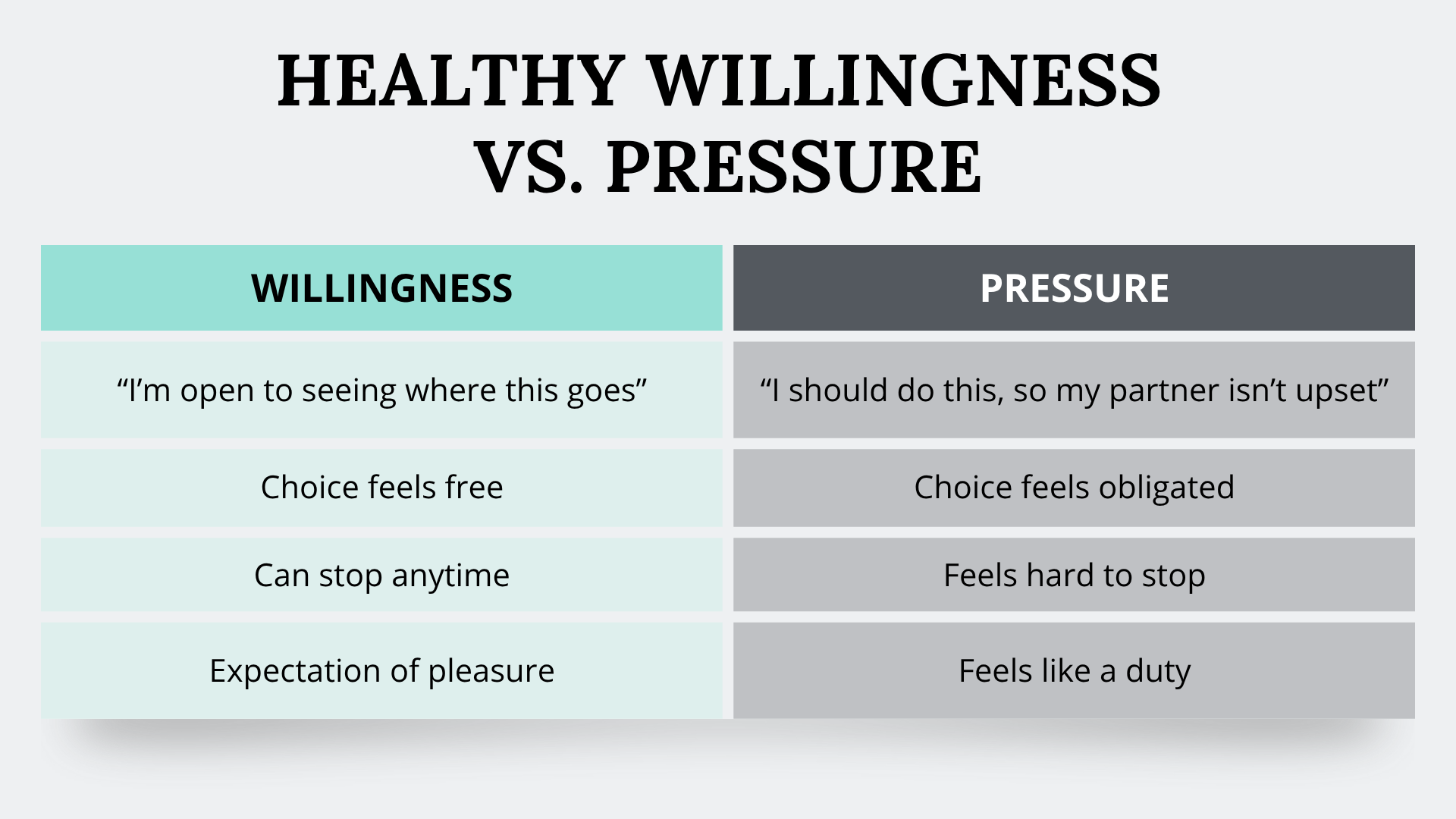
This is an important question. The willingness model is not about forcing yourself into sex or ignoring your boundaries.
Healthy willingness includes three key elements:
- Real Choice
- The person must feel fully free to say no
- If they feel guilt, pressure, or obligation, that is not willingness
- Expectation of Enjoyment
- Willingness comes from knowing, “I tend to enjoy this once we start.”
- If sex is uncomfortable or unpleasant, willingness won’t exist and shouldn’t be pushed.
- The Ability to stop
- Consent continues throughout the interaction
- Someone can start with willingness and later realize, “Actually, I’m not feeling it tonight.”
- Stopping is always okay.
The Goal for Couples
The goal isn’t convincing someone into having sex. The goal is creating conditions where desire has room to appear.
This looks like:
- Affection without pressure
- Playfulness and flirting
- Emotional safety
- Time to warm up
Exercise: How To Communicate Willingness in Real Time
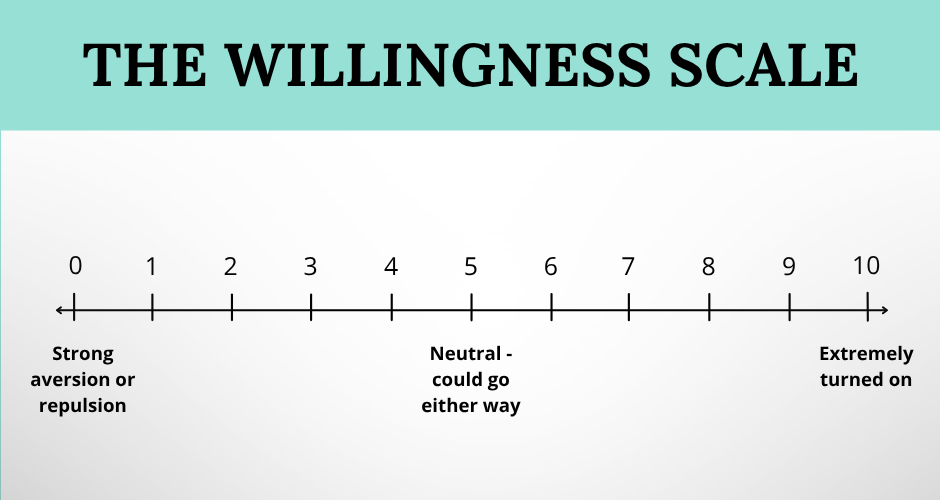
Sometimes partners struggle because they only communicate in two categories: yes or no. In reality, desire exists on a spectrum.
This exercise helps partners communicate where they are without pressure or misunderstanding.
Step 1: Use a 0-10 Willingness Scale
Step 2: Check In With Yourself
Before communicating with your partner, ask yourself:
- Where am I on the scale right now?
- Am I open to moving up the scale if we start with affection?
- What kind of touch or connection would feel comfortable?
For example:
- “I’m at about a 6. I’m not turned on yet, but I’m open to cuddling or making out.”
- “I’m at a 3 tonight. I’m really tired and probably won’t move up the scale.”
Step 3: Communicate the Number
Partners share their number without judgment.
Examples:
- “I’m at a 7 tonight.”
- “I’m around a 5, but I could probably move up with some slow connection.”
- “I’m at a 2 tonight. I need rest.”
This removes the pressure of guessing or interpreting rejection.
Step 4: Negotiate the Starting Point
Instead of deciding sex or no sex, couples ask: “What would feel good at our current numbers?”
For example:
- Cuddling
- Massage
- Kissing
- Going to sleep together
Sometimes numbers increase naturally once connection begins. Sometimes they don’t and that’s okay.
We hope this perspective helps shift the way you think about desire, taking some of the pressure off and opening up new ways to connect with your partner. For many couples, simply understanding that desire doesn’t have to come first can be a huge relief and a meaningful step toward more satisfying intimacy. And like any new way of thinking or communicating, it can take practice.
If you find yourselves still feeling stuck, discouraged, or unsure of how to apply this in your relationship, you’re not alone and you don’t have to navigate it on your own. Working with a sex therapist can help you build confidence, improve communication, and create a version of intimacy that feels good for both of you.
References
Nagoski, E. (2015). Come as you are: The surprising new science that will transform your sex life. Simon & Schuster.
Loulan, J. (1984). Lesbian sex. Spinsters Ink.
Recent Comments